旧キャプション廃棄。From the series "OKINAWA SOUL—Life with US Military Bases"
沖縄ソウル―基地を取り巻く人々
- Birth Year
- 1953
- Death Year
- -
- Date
- 1996 (printed in 2010)
- Technique, Material, Format
- gelatin silver print
- Dimension
- 20.7 x 30.4 cm
- Category
- Photograph or Moving Image by JapanesePhotographer/Artist
- Inventory Number
- 2009-PHJ-044
I have been photographing people in Okinawa living with and around the U.S. bases—American soldiers at the base and in the bars, Okinawan women married to U.S. soldiers, Okinawans working on the bases, the community divided by the pros and cons of the construction of a new base, the owners of the land used by the military, the anti-war landowners, women working in the bars for foreigners, the villages in close terms with the base, and so on.
Some people shout "Get rid of the U.S. bases!" while others say "outlives depend on the bases." Both are Okinawans.
The majority of the U.S. soldiers are pleasant, cheerful guys when they take their uniforms off and go back to being regular young American men. However, I hate the way the U.S. military tries to justify the indiscriminate killing of unarmed people, from babies to the elderly.
Many American soldiers have left for Iraq from Okinawa. What will happen to Okinawa, which has the greatest concentration of U.S. bases? I will continue to photograph the "life with the bases" in Okinawa.
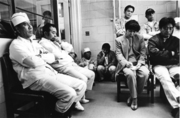
This dairy products plant produces milk and cheese for the soldiers, civilians, and their families on the base. One day, the U.S. military announced it was discontinuing its contract with the manufacturer and closing the plant. What will happen to them? The workers are so worried they can't sleep: their expressions are sad and depressed.
(In Camp Kinzer, Urasoe, Okinawa, January 9, 1996)
Towards the end of World War II, Okinawa became the site of a fierce ground battle that took the lives of many civilians, and after the war it was placed under the control of the United States for many years. Born and raised in Okinawa under U.S. rule, Ishikawa Mao chose to become a photographer in 1971, the year before Okinawa was returned to Japan. After the return, it became clear that the United States would retain military bases on the island, provoking mass demonstrations in which Ishikawa herself participated. Ishikawa does not discriminate in her work, taking photos of any and all sorts of people who have a connection with the U.S. bases—from soldiers stationed there to base opponents and proponents. Rather than depicting Okinawa from the perspective of this or that side of politics, she tries to capture an image of the island as it is talked about by the many varied people who shape it.
*You can also view other works from the same series.(KIMURA Eriko)