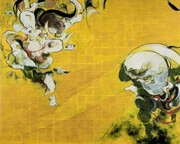
This painting is based on Tawaraya Sotatsu’s Wind God and Thunder God Screens, which are an important cultural property. The original consists of a pair of two-fold screens, with the Wind God and Thunder God located at the extremities. In this work, the space between the pair is compressed, and the movement that is implied in the original is emphasized here by depicting them as though they are spinning. They are like cartoon characters whose forms have been distorted to represent motion. While Fukuda Miran had long created parodies of masterpieces, her works tended to be figurative. But from around 2008, she began to tackle abstract paintings as "a problem that all painters must confront." This work should be seen as part of that effort.
(MINAMISHIMA Ko)


This painting is based on Tawaraya Sotatsu’s Wind God and Thunder God Screens, which are an important cultural property. The original consists of a pair of two-fold screens, with the Wind God and Thunder God located at the extremities. In this work, the space between the pair is compressed, and the movement that is implied in the original is emphasized here by depicting them as though they are spinning. They are like cartoon characters whose forms have been distorted to represent motion. While Fukuda Miran had long created parodies of masterpieces, her works tended to be figurative. But from around 2008, she began to tackle abstract paintings as "a problem that all painters must confront." This work should be seen as part of that effort.
(MINAMISHIMA Ko)