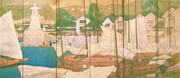
This work depicts Tomonoura (in Fukuyama, Hiroshima Prefecture), a scenic spot on the Seto Inland Sea near artist Ono Chikkyo’s hometown of Kasaoka in Okayama Prefecture. Tomonoura is the only port town in Japan where the Edo Period (1603–1868) port facilities remain intact. On the left is a stone pagoda with people on the stone steps leading up to it, and on the right numerous boats lie at anchor in front of storehouse-style houses. The bold composition of the painting, with its many vertical masts and the departing ship cut off at the painting’s left edge, is eye-catching, and the use of the Western pointillist technique, with dots used to depict the masts, the mountains in the background, and the roofs of the houses is also surprising. The work suggests a young artist pursuing realistic depictions of landscapes using Japanese inks and materials. It represents an attempt to develop new forms of expression.
(HASEGAWA Tamao)
This work depicts Tomonoura (in Fukuyama, Hiroshima Prefecture), a scenic spot on the Seto Inland Sea near artist Ono Chikkyo’s hometown of Kasaoka in Okayama Prefecture. Tomonoura is the only port town in Japan where the Edo Period (1603–1868) port facilities remain intact. On the left is a stone pagoda with people on the stone steps leading up to it, and on the right numerous boats lie at anchor in front of storehouse-style houses. The bold composition of the painting, with its many vertical masts and the departing ship cut off at the painting’s left edge, is eye-catching, and the use of the Western pointillist technique, with dots used to depict the masts, the mountains in the background, and the roofs of the houses is also surprising. The work suggests a young artist pursuing realistic depictions of landscapes using Japanese inks and materials. It represents an attempt to develop new forms of expression.
(HASEGAWA Tamao)