From the late 1950s, Pablo Picasso became enthusiastic about printmaking using linoleum. A form of relief printing, "linocut," as the technique is known, involves cutting a design into a linoleum plate and then applying ink to the areas that remain. But instead of preparing one separate plate for each color, Picasso developed a method of progressively carving the same plate and printing different colors from it as he went. This reduction process is necessarily restrictive, because once a plate has been carved it cannot be undone, but Picasso saw in this limitation a creative challenge affording new possibilities. Here he has actively incorporated imagery as it emerged during the production process, creating a unique series that captures a gradually evolving vision of a woman.
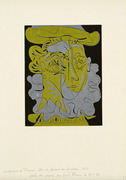
This is from the second stage. The areas of yellow are what was left after the plate was carved some more. Compared to the first stage, Picasso has been quite bold in carving away the linoleum plate.
From the late 1950s, Pablo Picasso became enthusiastic about printmaking using linoleum. A form of relief printing, "linocut," as the technique is known, involves cutting a design into a linoleum plate and then applying ink to the areas that remain. But instead of preparing one separate plate for each color, Picasso developed a method of progressively carving the same plate and printing different colors from it as he went. This reduction process is necessarily restrictive, because once a plate has been carved it cannot be undone, but Picasso saw in this limitation a creative challenge affording new possibilities. Here he has actively incorporated imagery as it emerged during the production process, creating a unique series that captures a gradually evolving vision of a woman.
This is from the second stage. The areas of yellow are what was left after the plate was carved some more. Compared to the first stage, Picasso has been quite bold in carving away the linoleum plate.
(SAKAMOTO Kyoko)
*You can see other works from this series .