Gravestones are scattered along the diagonal ridgelines that run upwards from the left and the right. Each grave is elongated vertically, reinforcing the verticality of the painting. The surrounding area is rendered using the pointillist technique—clusters of dots ranging from white to yellowish, like air. Kokuryo Tsunero began employing pointillism in the late 1960s. This work belongs to a period the artist himself classified as having a “Cubist-style tendency toward fragmented composition.” This likely means the picture plane is created by breaking down the subject—a cemetery—into several planes and then reconfiguring them. While the painting is evocative of the Yokohama Foreign General Cemetery, its composition of diagonal lines, vertical lines, and dots perhaps makes it the closest of the artist’s works to abstract painting. (MINAMISHIMA Ko)

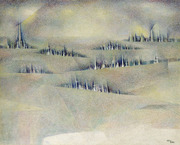
Gravestones are scattered along the diagonal ridgelines that run upwards from the left and the right. Each grave is elongated vertically, reinforcing the verticality of the painting. The surrounding area is rendered using the pointillist technique—clusters of dots ranging from white to yellowish, like air. Kokuryo Tsunero began employing pointillism in the late 1960s. This work belongs to a period the artist himself classified as having a “Cubist-style tendency toward fragmented composition.” This likely means the picture plane is created by breaking down the subject—a cemetery—into several planes and then reconfiguring them. While the painting is evocative of the Yokohama Foreign General Cemetery, its composition of diagonal lines, vertical lines, and dots perhaps makes it the closest of the artist’s works to abstract painting.
(MINAMISHIMA Ko)