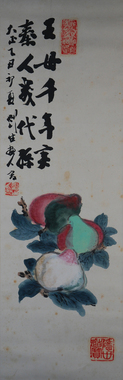
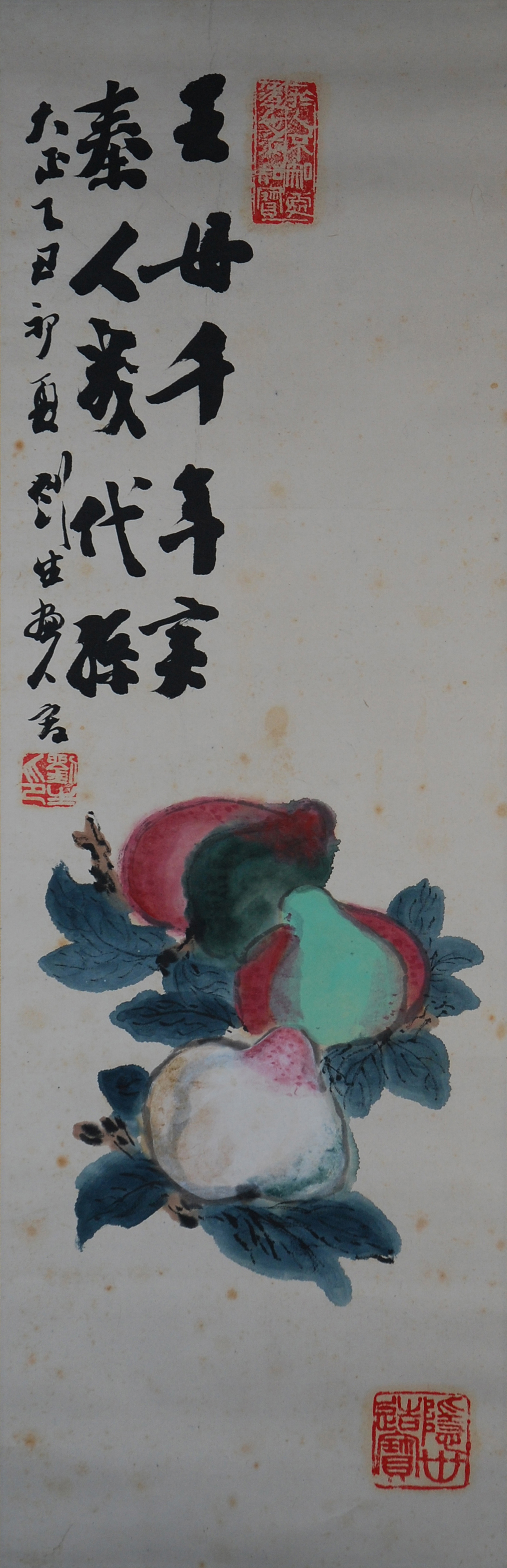
Kishida Ryusei was originally an avid student of European painting, making portraits of friends and family, still lifes, and landscapes in oil and watercolor. But in around 1920, he became interested in oriental art and began using oriental art materials. This painting is the result of such experimentation. The three peaches are vividly expressed by the blurring and shading of color and the movement of lines. An inscription above them reads, "Queen Mother of the Qin Dynasty for millennia." This is a reference to Xi Wangmu, a legendary Chinese goddess known as the "Queen Mother of the West." She is said to have offered a sacred peach that bore fruit only once every 3,000 years to Emperor Wu of the Han Dynasty, who wished for longevity. For this reason, peaches like these were a popular congratulatory motif symbolizing long life in Japan and they appeared in many of Ryusei’s paintings.
(KASHIWAGI Tomoh)

Kishida Ryusei was originally an avid student of European painting, making portraits of friends and family, still lifes, and landscapes in oil and watercolor. But in around 1920, he became interested in oriental art and began using oriental art materials. This painting is the result of such experimentation. The three peaches are vividly expressed by the blurring and shading of color and the movement of lines. An inscription above them reads, "Queen Mother of the Qin Dynasty for millennia." This is a reference to Xi Wangmu, a legendary Chinese goddess known as the "Queen Mother of the West." She is said to have offered a sacred peach that bore fruit only once every 3,000 years to Emperor Wu of the Han Dynasty, who wished for longevity. For this reason, peaches like these were a popular congratulatory motif symbolizing long life in Japan and they appeared in many of Ryusei’s paintings.
(KASHIWAGI Tomoh)