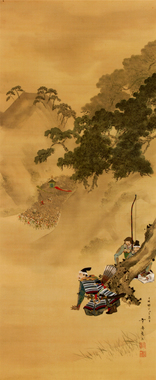

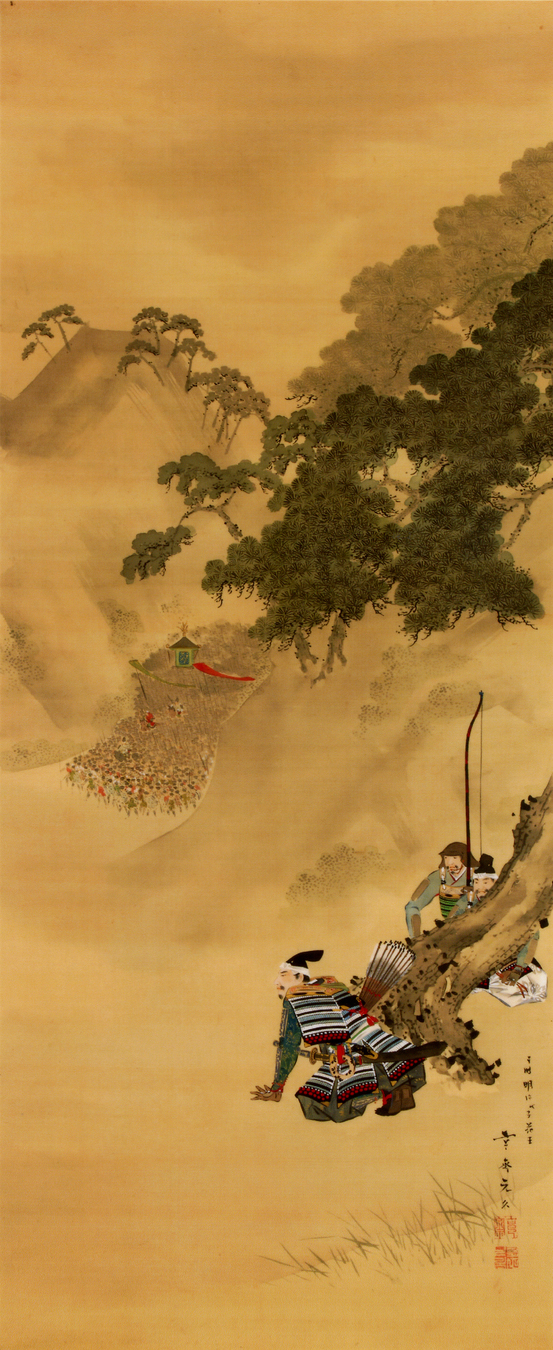
Samurai Warlord Kusunoki Masashige Awaiting the Return of Emperor Godaigo
迎後醍醐帝楠子図
- Birth Year
- 1819
- Death Year
- 1896
- Date
- 1888
- Technique, Material, Format
- color on silk, hanging scroll
- Dimension
- 122.2 x 50.2 cm
- Category
- Nihonga (Japanese-style Painting)
- Inventory Number
- 2013-JP-004
Nakajima Kyosai was a painter born in the later years of the Edo Period (1603–1868). He studied under Kikuchi Yosai, who specialized in historical portraits and events. He also worked as a production assistant for Yosai’s book Zenken Kojitsu (Wise Men of the Past), which includes portraits of 585 historical figures coupled with brief biographies, and later opened a school in Yokohama where he taught historical painting. This work depicts the military commander Kusunoki Masashige greeting Emperor Godaigo on the latter’s way back to Kyoto from Oki Island, where he had been exiled. During the Meiji Period (1868–1912), an emperor-centric view of history became popular, and the famously loyal retainer Kusunoki (whose honorific titles included Nanko and Nanshi) was a popular subject. While this is a typical depiction of Nanko modeled after Zenken Kojitsu, Kyosai’s depiction of his powerful hands and feet expresses Nanko’s dedication to his mission, and his physical presence is palpable.
(UCHIYAMA Junko)