Matsumoto Fuko initially studied under painters of the Kano school, which was aligned with the Edo shogunate. After the Meiji Restoration (1868), he became a disciple of artist Kikuchi Yosai, who was well versed in both old and new schools of art. Matsumoto went on to establish his own painting school that specialized in historical portraiture and produced many famous artists, including Yokohama-native Imamura Shiko.
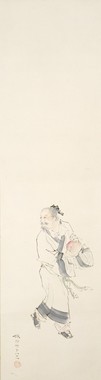
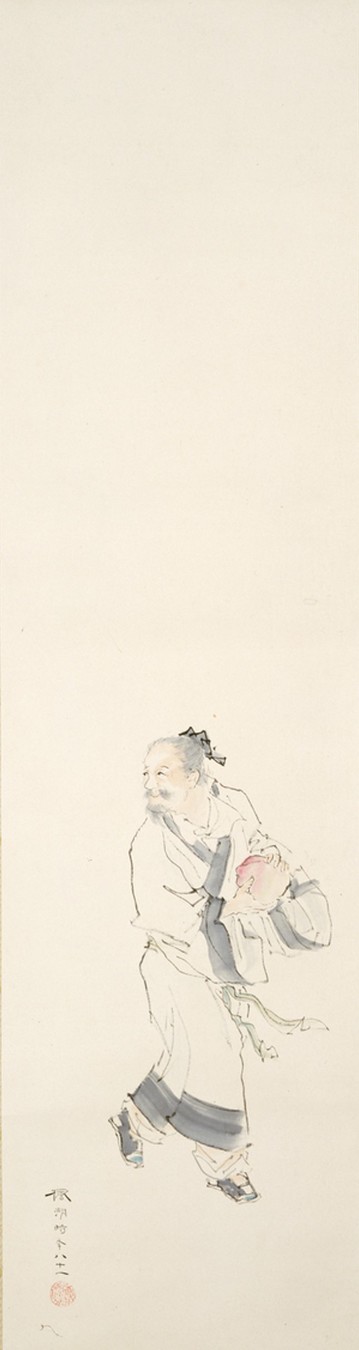
This painting was made in Matsumoto’s later years. The subject is Dongfang Shuo, an official who worked under Emperor Wu during China’s Western Han dynasty. Dongfang is sometimes depicted with Xi Wangmu, the "Queen Mother of the West." The Queen was a legendary goddess who lived in the Kunlun mountains, a mythical place that was worshiped since ancient times. She is said to have maintained a special orchard of peaches of immortality, which ripened only every 3,000 years. Having stolen peaches from the orchard on three occasions, Dongfang lived to a very old age. The motif seen here, with Dongfang holding a peach, became an auspicious way to wish for and celebrate longevity.
(YATSUYANAGI Sae)

Matsumoto Fuko initially studied under painters of the Kano school, which was aligned with the Edo shogunate. After the Meiji Restoration (1868), he became a disciple of artist Kikuchi Yosai, who was well versed in both old and new schools of art. Matsumoto went on to establish his own painting school that specialized in historical portraiture and produced many famous artists, including Yokohama-native Imamura Shiko.
This painting was made in Matsumoto’s later years. The subject is Dongfang Shuo, an official who worked under Emperor Wu during China’s Western Han dynasty. Dongfang is sometimes depicted with Xi Wangmu, the "Queen Mother of the West." The Queen was a legendary goddess who lived in the Kunlun mountains, a mythical place that was worshiped since ancient times. She is said to have maintained a special orchard of peaches of immortality, which ripened only every 3,000 years. Having stolen peaches from the orchard on three occasions, Dongfang lived to a very old age. The motif seen here, with Dongfang holding a peach, became an auspicious way to wish for and celebrate longevity.
(YATSUYANAGI Sae)