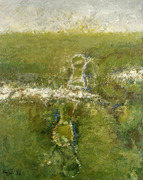
Sato Kei was selected for the Imperial Fine Arts Academy Exhibition (Teiten) held by the Ministry of Education while he was still a student. The following year, he traveled to France, where he was inspired by the work of Pablo Picasso, Henri Matisse, and Fujita Tsuguharu (Léonard Foujita). Works created during his stay in Europe were awarded special prize at Teiten. However, he soon chose to pursue his own artistic inclinations free from the influence of the government and so founded a new group with his peers. After World War II, he relocated to Paris in 1952. By the 1960s, he had established his own style of abstract painting characterized by thick layering of paint. This canvas is dominated by greens reminiscent of a forest. In the center, a form resembling a keyhole-shaped kofun burial mound can be seen. The texture of the paint, reminiscent of fossilized skin, seems to capture within it the passage of time from long ago and the thoughts of countless generations past. (YATSUYANAGI Sae)
Sato Kei was selected for the Imperial Fine Arts Academy Exhibition (Teiten) held by the Ministry of Education while he was still a student. The following year, he traveled to France, where he was inspired by the work of Pablo Picasso, Henri Matisse, and Fujita Tsuguharu (Léonard Foujita). Works created during his stay in Europe were awarded special prize at Teiten. However, he soon chose to pursue his own artistic inclinations free from the influence of the government and so founded a new group with his peers. After World War II, he relocated to Paris in 1952. By the 1960s, he had established his own style of abstract painting characterized by thick layering of paint. This canvas is dominated by greens reminiscent of a forest. In the center, a form resembling a keyhole-shaped kofun burial mound can be seen. The texture of the paint, reminiscent of fossilized skin, seems to capture within it the passage of time from long ago and the thoughts of countless generations past.
(YATSUYANAGI Sae)