Look closely and a figure resembling a skeleton emerges from this arrangement of lines and shapes. It seems to be grasping something with chopsticks and trying to bring it to its mouth. Its eyes appear somewhat distraught, and beneath the face there is another upside-down skull-like object. Tsuruoka Masao, who served in the military in China from 1937, lost most of his paintings in the GreatTokyo Air raids. Capturing the gloomy mood of the postwar era, his painting Heavy Hand (Museum of Contemporary Art Tokyo) is one of his best-known works. This painting also shows the human body reduced to symbols, and there is a sharp sense of satire and humor. It was exhibited in 1954 at the 18th Art Exhibition by Jiyu Bijutsu alongside Rain, which is also in the museum’s collection. (MINAMISHIMA Ko)
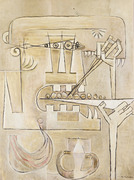
Look closely and a figure resembling a skeleton emerges from this arrangement of lines and shapes. It seems to be grasping something with chopsticks and trying to bring it to its mouth. Its eyes appear somewhat distraught, and beneath the face there is another upside-down skull-like object. Tsuruoka Masao, who served in the military in China from 1937, lost most of his paintings in the GreatTokyo Air raids. Capturing the gloomy mood of the postwar era, his painting Heavy Hand (Museum of Contemporary Art Tokyo) is one of his best-known works. This painting also shows the human body reduced to symbols, and there is a sharp sense of satire and humor. It was exhibited in 1954 at the 18th Art Exhibition by Jiyu Bijutsu alongside Rain, which is also in the museum’s collection.
(MINAMISHIMA Ko)