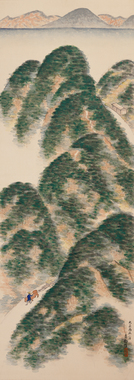
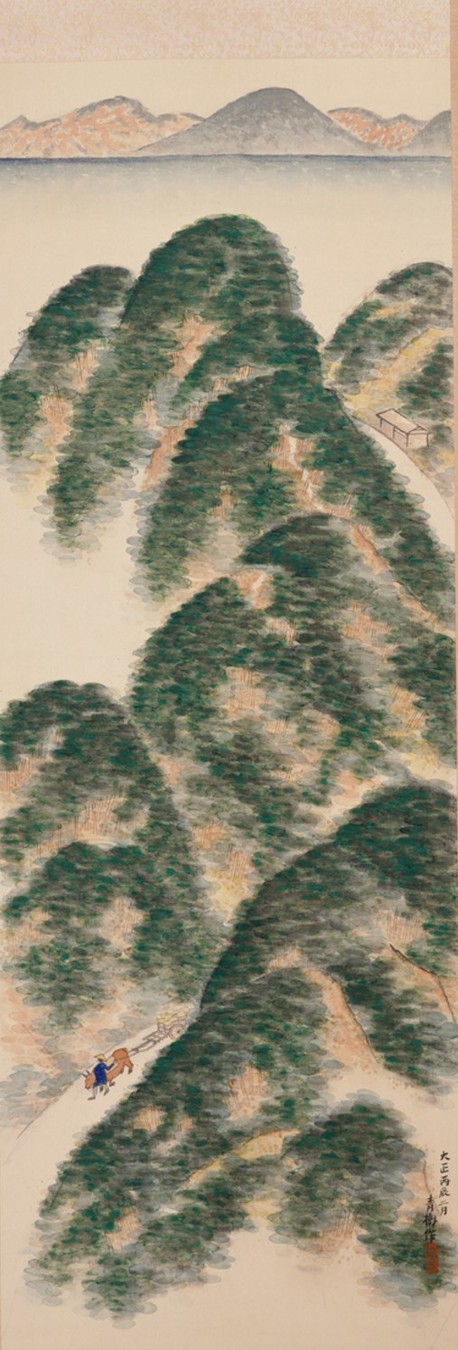
This bright and serene landscape painting employs pointillism with ellipse-shaped dots to depict trees and the surface of the water. The format is vertical, in the style of Eastern painting. Alongside his more senior apprentice contemporary Imamura Shiko and his peers like Hayami Gyoshu, Omoda Seiju was one of several artists who strove to adapt Nihonga (modern Japanese-style painting) to the contemporary era. Their endeavors incorporated elements of Nanga (a genre developed uniquely in Japan, drawing on China’s Southern School of painting) as well as characteristics of Western Impressionism. This painting is also suggestive of those efforts. On a day when both the sea and mountains are calm, the man leading the ox through the mountains looks utterly content. It suggests that their new version of Nihonga was characterized by freedom, leisure, and magnanimity. (HIBINO Miyon)

This bright and serene landscape painting employs pointillism with ellipse-shaped dots to depict trees and the surface of the water. The format is vertical, in the style of Eastern painting. Alongside his more senior apprentice contemporary Imamura Shiko and his peers like Hayami Gyoshu, Omoda Seiju was one of several artists who strove to adapt Nihonga (modern Japanese-style painting) to the contemporary era. Their endeavors incorporated elements of Nanga (a genre developed uniquely in Japan, drawing on China’s Southern School of painting) as well as characteristics of Western Impressionism. This painting is also suggestive of those efforts. On a day when both the sea and mountains are calm, the man leading the ox through the mountains looks utterly content. It suggests that their new version of Nihonga was characterized by freedom, leisure, and magnanimity.
(HIBINO Miyon)