
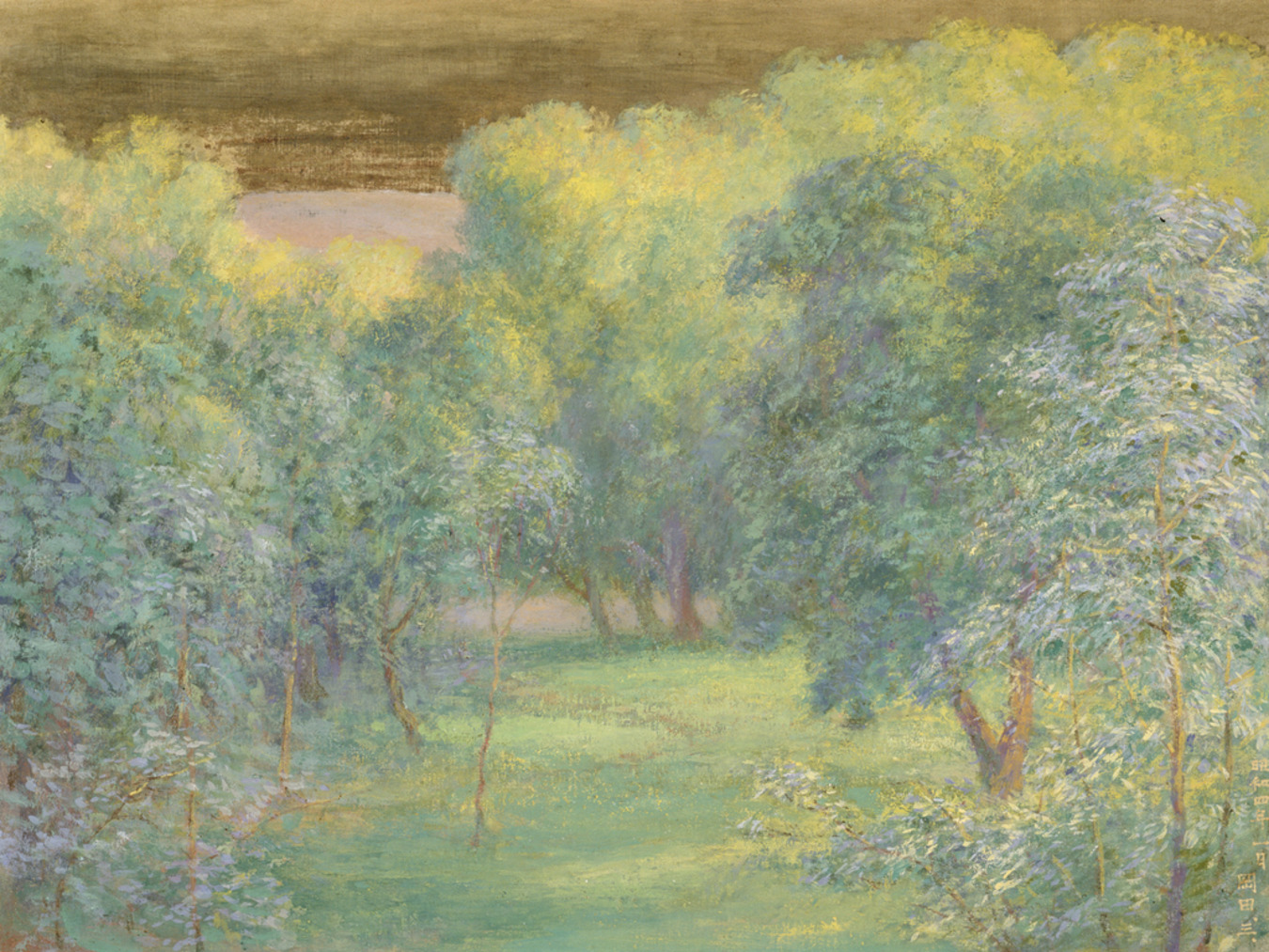
Scenery
風景
- Birth Year
- 1869
- Death Year
- 1939
- Date
- 1929
- Technique, Material, Format
- oil and mineral pigment on canvas
- Dimension
- 57.0 x 77.0 cm
- Donor name
- Mr. Igarashi Yoshimasa
- Category
- Oil or Other Painting by Japanese Artist
- Inventory Number
- 87-OJ-003
Okada Saburosuke is known for his contributions to the development of Western-style painting in Japan, but from around the late Meiji Era (1868–1912) he also made works using the mineral pigments of Nihonga (modern Japanese-style painting). Many artists after the Meiji Era grappled with the question of what should be considered the true “Japanese painting.” Okada seems to have approached the problem with a focus not on technique or form, but on materials. At first glance, this work employs familiar Western techniques, so it is not immediately apparent that it is actually made with Nihonga pigments. Furthermore, Okada believed that modern, newly developed artificial mineral pigments offered superior permanence compared to natural ones or oil paints. Consequently, he used artificial mineral pigments for paintings gifted to the Imperial family and for the murals he made at the Meiji Memorial Picture Gallery in Meiji Shrine, Tokyo.
(HIBINO Miyon)