Matsuo Toshio was one of several artists who supported the activities of the Nihon Bijutsuin after World War II. His gentle, serene depictions of flowers, especially peonies, were popular. From the 1970s onward, he traveled to Europe, China, and India for research, trying his hand at genre paintings and landscapes. His large-scale works like this one possess a sense of drama, meticulously combining different elements in relationships of tension. In the foreground lies a massive tree, its thick branches spread akimbo as if freshly battered by fierce wind and snow. Beyond it, a bird of prey soars against a vast expanse of blue sky, wings spread and gaze sharp. At the base of the tree, a lush young sapling suggests new life emerging after the blizzard. The pure, clear, and serene color palette is suggestive not of nature’s fury, but rather of the hope of life, cycling with the passage of time. (YATSUYANAGI Sae)

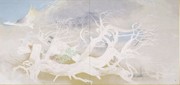
Matsuo Toshio was one of several artists who supported the activities of the Nihon Bijutsuin after World War II. His gentle, serene depictions of flowers, especially peonies, were popular. From the 1970s onward, he traveled to Europe, China, and India for research, trying his hand at genre paintings and landscapes. His large-scale works like this one possess a sense of drama, meticulously combining different elements in relationships of tension. In the foreground lies a massive tree, its thick branches spread akimbo as if freshly battered by fierce wind and snow. Beyond it, a bird of prey soars against a vast expanse of blue sky, wings spread and gaze sharp. At the base of the tree, a lush young sapling suggests new life emerging after the blizzard. The pure, clear, and serene color palette is suggestive not of nature’s fury, but rather of the hope of life, cycling with the passage of time.
(YATSUYANAGI Sae)