Sculpture or Three-dimensional Work by Foreign Artist
Inventory Number
88-SF-002
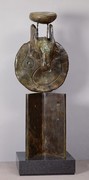
Joan Miró began actively making sculptures around 1944. At first, he made them in clay and fired them in a kiln. Later he changed his approach, assembling refuse and natural objects he found at the beach and in the street to create tower-like figures, which he then cast in bronze. In this piece, the lower half of the figure is cast from an L-shaped piece of construction material, while the upper half is cast from a piece the artist made in clay. The front is engraved with the teardrops and constellations often found in Miró’s paintings, while the back is adorned with stars and crescent moons. The circular face has rabbit-like ears and a monster’s nose. A bowl-shaped creature stands on two legs atop the head. The lower half of the body opens like a door. Miró’s statue pieces like this one are often referred to as his "monsters." They contain a message of resistance against Franco’s dictatorship in Spain.
(NAKAMURA Naoaki)
Joan Miró began actively making sculptures around 1944. At first, he made them in clay and fired them in a kiln. Later he changed his approach, assembling refuse and natural objects he found at the beach and in the street to create tower-like figures, which he then cast in bronze. In this piece, the lower half of the figure is cast from an L-shaped piece of construction material, while the upper half is cast from a piece the artist made in clay. The front is engraved with the teardrops and constellations often found in Miró’s paintings, while the back is adorned with stars and crescent moons. The circular face has rabbit-like ears and a monster’s nose. A bowl-shaped creature stands on two legs atop the head. The lower half of the body opens like a door. Miró’s statue pieces like this one are often referred to as his "monsters." They contain a message of resistance against Franco’s dictatorship in Spain.
(NAKAMURA Naoaki)