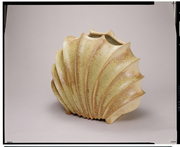
A large clam shell-like object stands with its two sides slightly ajar. The organic shape inspired by nature is created with smooth but sharply edged curves. Gerd Knäpper has made use of the clay’s natural color, but he has also adjusted his firing technique to give the work a brownish tinge and create the appearance of a shell. Born in Germany, he traveled the world in the hope of becoming a craftsman and developed an interest in Japanese ceramics while living in the U.S. His first trip to Japan, in 1966, resulted in him receiving training in Seto and Mashiko, before he eventually established his own kiln in the town of Daigomachi in Ibaraki Prefecture. He said that “form” was his means of expression and that he was always conscious of harmonizing his work with the space it inhabited. To achieve this, he not only made ceramics, but also sometimes did metalwork. (HASEGAWA Tamao)
A large clam shell-like object stands with its two sides slightly ajar. The organic shape inspired by nature is created with smooth but sharply edged curves. Gerd Knäpper has made use of the clay’s natural color, but he has also adjusted his firing technique to give the work a brownish tinge and create the appearance of a shell. Born in Germany, he traveled the world in the hope of becoming a craftsman and developed an interest in Japanese ceramics while living in the U.S. His first trip to Japan, in 1966, resulted in him receiving training in Seto and Mashiko, before he eventually established his own kiln in the town of Daigomachi in Ibaraki Prefecture. He said that “form” was his means of expression and that he was always conscious of harmonizing his work with the space it inhabited. To achieve this, he not only made ceramics, but also sometimes did metalwork.
* You can see a metalwork of this artist.(HASEGAWA Tamao)