
Lady Kogo, from Noh Play
小督
- Birth Year
- 1809
- Death Year
- 1892
- Date
- n.d.
- Technique, Material, Format
- color on silk, pair of hanging scrolls
- Dimension
- each 108.4 x 27.0 cm
- Donor name
- Mr. Matsuura Shintaro
- Category
- Nihonga (Japanese-style Painting)
- Inventory Number
- 91-JP-01G
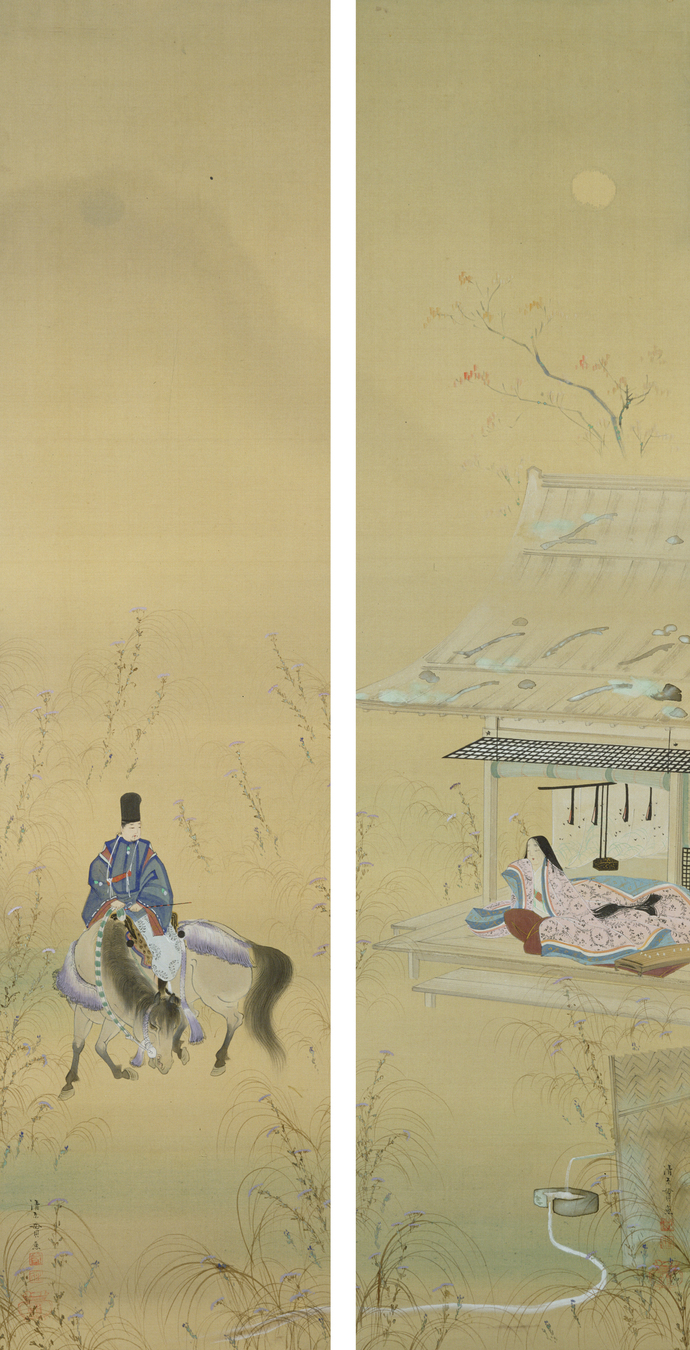
Kogo was a woman in the favor of the Emperor Takakura toward the end of the Heian Period (794–1185). She was beautiful and a skilled player of the Japanese instrument the koto. However, because she was better liked by the Emperor than the daughter of the powerful Taira no Kiyomori, she was fearful of Kiyomori’s wrath and so chose to go into hiding in Sagano. Grieving her absence, the Emperor ordered Minamoto no Nakakuni to find her and bring her back. This painting depicts the moment when Nakakuni, guided on a moonlit night by the sound of Kogo’s koto, responds by playing his flute. This tragic tale of a doomed love affair that unfolds in the late autumn fields was considered a traditional motif and was often taken up in paintings and Noh. Morizumi Tsurana was one of several artists during the Edo Period (1603–1868) and Meiji Era (1868–1912) who chose to depict traditional motifs like this frequently.
(YATSUYANAGI Sae)