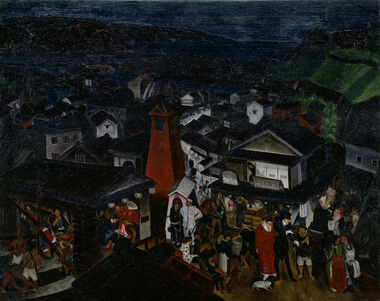
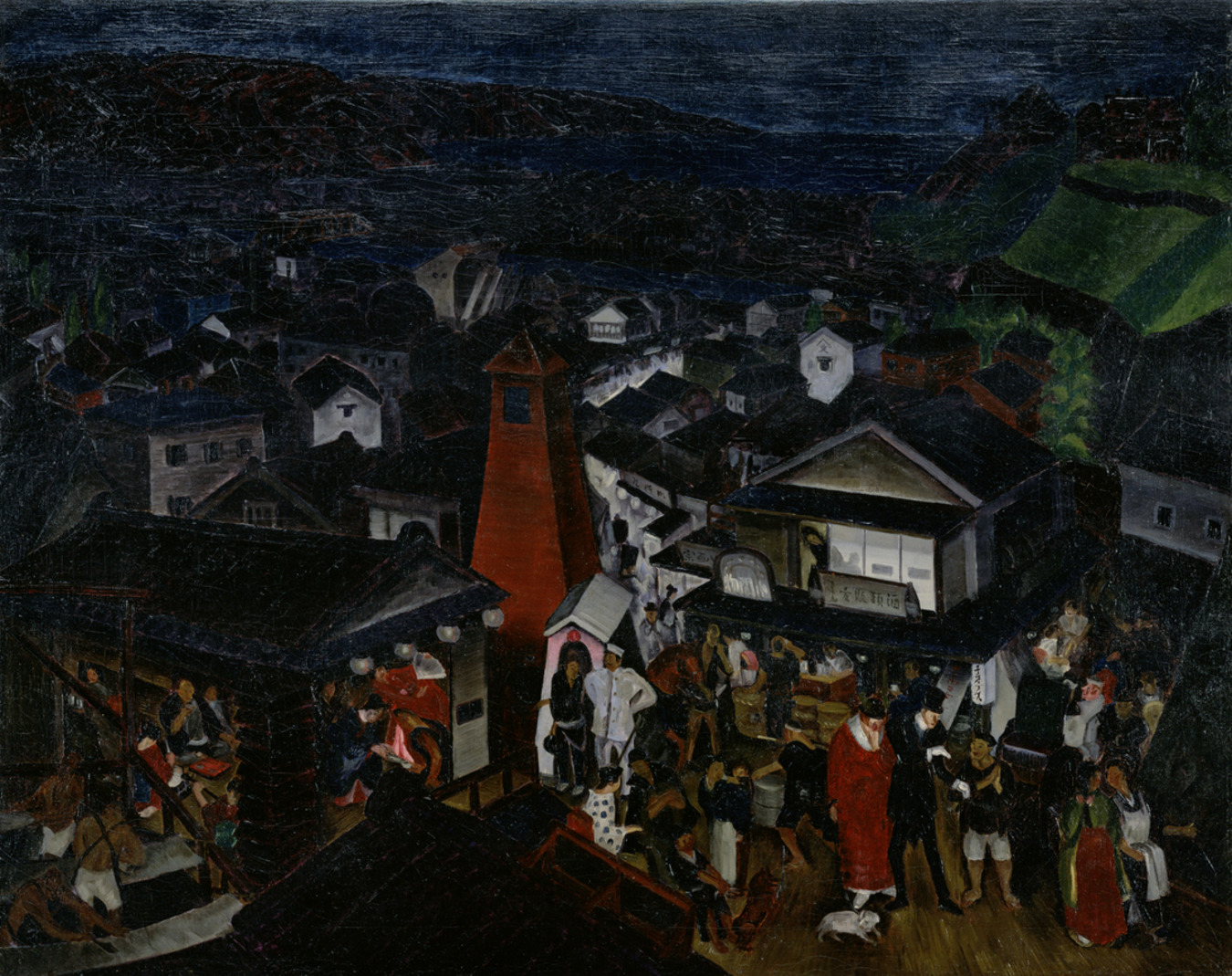
In the fall of 1919, Shimizu Toshi arrived in Japan for the first time since moving to the United States 12 years earlier at the age of 20. After holding his wedding, which was the purpose of this temporary visit, he travelled to Yokohama in March 1920 with his new wife. Yokohama Night (Impression of Yokohama) was based on photographs he took at Isezakicho during that visit, but the painting was not made until after he had returned to New York. The scene conveys Yokohama’s bustling nightlife, with a foreign couple asking for directions, geisha at a restaurant, fighting dogs, and police officers. A variation of this painting (with the same composition) was initially earmarked for an award at the Thirty-Fourth Annual Exhibition of American Painting and Sculpture at the Art Institute of Chicago, but this selection was later controversially reversed due to Shimizu’s foreign nationality. While that painting missed the award, it nevertheless won high praise from the judges and brought the artist recognition for the first time. It has recently come to light that the work in the Yokohama Museum of Art collection is not the painting that was submitted for the award in Chicago, but a variation with the same composition made in July 1921. (KATADA Yuko)

In the fall of 1919, Shimizu Toshi arrived in Japan for the first time since moving to the United States 12 years earlier at the age of 20. After holding his wedding, which was the purpose of this temporary visit, he travelled to Yokohama in March 1920 with his new wife. Yokohama Night (Impression of Yokohama) was based on photographs he took at Isezakicho during that visit, but the painting was not made until after he had returned to New York. The scene conveys Yokohama’s bustling nightlife, with a foreign couple asking for directions, geisha at a restaurant, fighting dogs, and police officers. A variation of this painting (with the same composition) was initially earmarked for an award at the Thirty-Fourth Annual Exhibition of American Painting and Sculpture at the Art Institute of Chicago, but this selection was later controversially reversed due to Shimizu’s foreign nationality. While that painting missed the award, it nevertheless won high praise from the judges and brought the artist recognition for the first time. It has recently come to light that the work in the Yokohama Museum of Art collection is not the painting that was submitted for the award in Chicago, but a variation with the same composition made in July 1921.
(KATADA Yuko)