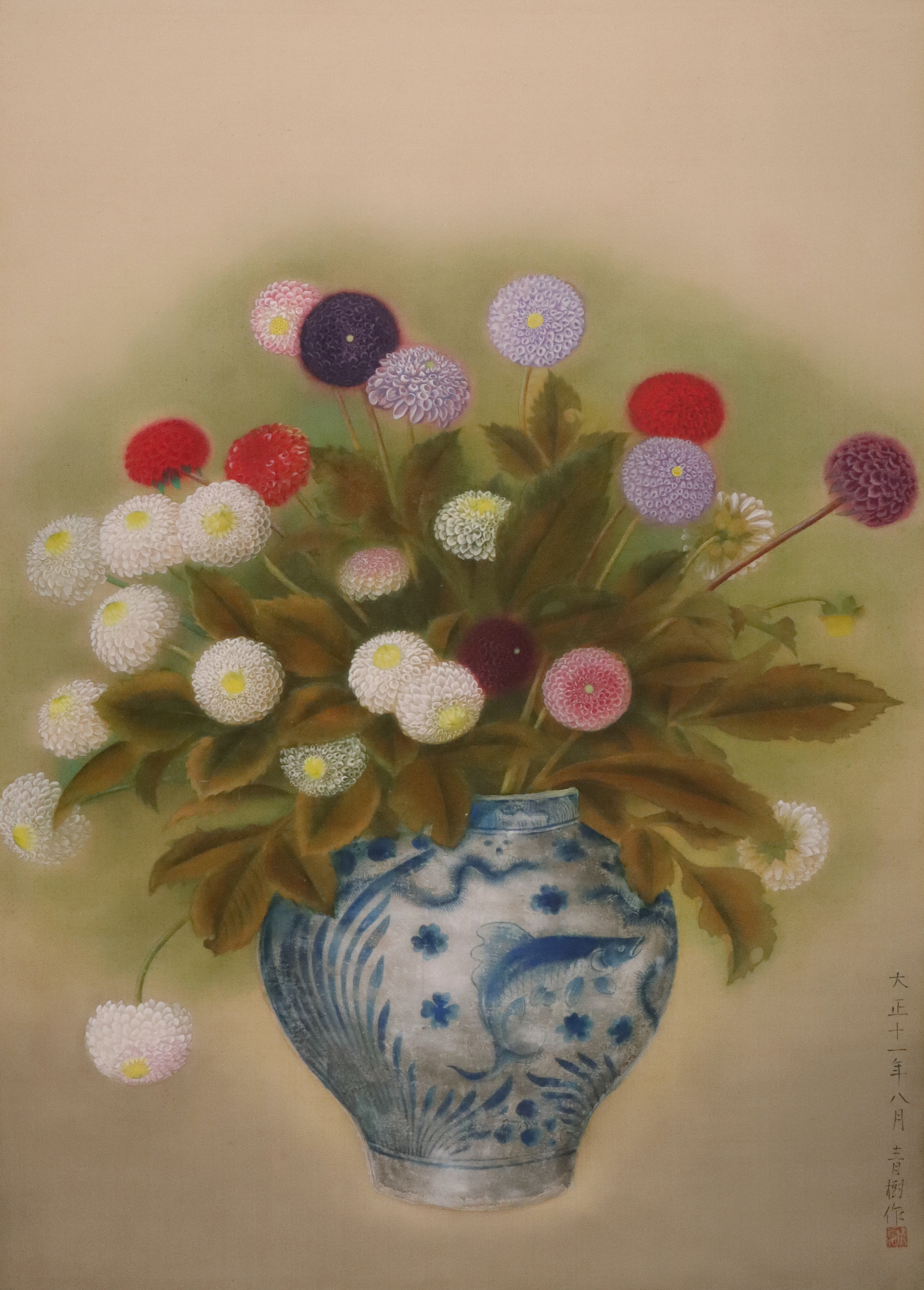
Colorful pompon dahlias are arranged in a bulbous vase. Even the petals are captured in fine detail, conveying the flower’s soft demeanor. This particular vase was a favorite of Omoda Seiju. Dating from the Yuan dynasty (1279–1368) in China, it was owned by the Imperial Household Museum (now the Tokyo National Museum), and the artist often went to sketch it, gradually learning to recreate its lustrous porcelain texture. Omoda also made a daily routine of sketching flowers and small animals in his garden, and it is believed he also drew pompon dahlias there. This routine likely sharpened his ability to observe and accurately capture details. His vivid imagination is also evident in this work, in that he has combined familiar flowers with a museum artefact, which in real life would of course be empty. (HASEGAWA Tamao)


Colorful pompon dahlias are arranged in a bulbous vase. Even the petals are captured in fine detail, conveying the flower’s soft demeanor. This particular vase was a favorite of Omoda Seiju. Dating from the Yuan dynasty (1279–1368) in China, it was owned by the Imperial Household Museum (now the Tokyo National Museum), and the artist often went to sketch it, gradually learning to recreate its lustrous porcelain texture. Omoda also made a daily routine of sketching flowers and small animals in his garden, and it is believed he also drew pompon dahlias there. This routine likely sharpened his ability to observe and accurately capture details. His vivid imagination is also evident in this work, in that he has combined familiar flowers with a museum artefact, which in real life would of course be empty.
(HASEGAWA Tamao)