This mass of glass seems to emit a soft light from within, or perhaps it is absorbing light. The simple form, matte finish, gentle hues, and freeform lines evoke a somehow cheerful warmth. Starting with a clay prototype, Ohgita Katsuya makes a concave plaster mold, applies soft colors to it and then packs it with granular glass. The glass is melted at high temperatures, slowly cooled and then removed from the mold. Known as cold casting, this technique holds all kinds of potential precisely because it relies on the simple natural forces of heat and gravity. Ohgita describes his work as an act of capturing the shape of light. This ambitious work was made using a large electric furnace he acquired in 1989. (HASEGAWA Tamao)

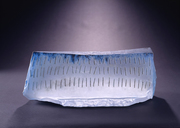
This mass of glass seems to emit a soft light from within, or perhaps it is absorbing light. The simple form, matte finish, gentle hues, and freeform lines evoke a somehow cheerful warmth. Starting with a clay prototype, Ohgita Katsuya makes a concave plaster mold, applies soft colors to it and then packs it with granular glass. The glass is melted at high temperatures, slowly cooled and then removed from the mold. Known as cold casting, this technique holds all kinds of potential precisely because it relies on the simple natural forces of heat and gravity. Ohgita describes his work as an act of capturing the shape of light. This ambitious work was made using a large electric furnace he acquired in 1989.
(HASEGAWA Tamao)