

The Gallic Round
ガリア人の輪舞
- Birth Year
- 1796
- Death Year
- 1875
- Date
- 1857 (published in 1921)
- Technique, Material, Format
- cliché-verre
- Dimension
- 18.3 x 14.2 cm
- Donor name
- Mr. Kojima Yutaka (formerly owned by Kojima Usui)
- Category
- Print by Foreign Artist
- Inventory Number
- 2003-PRF-042
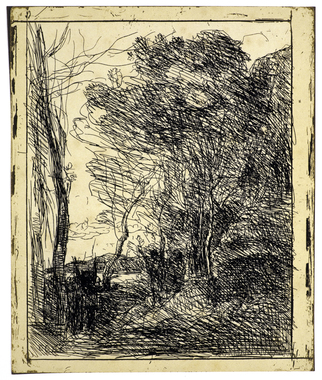
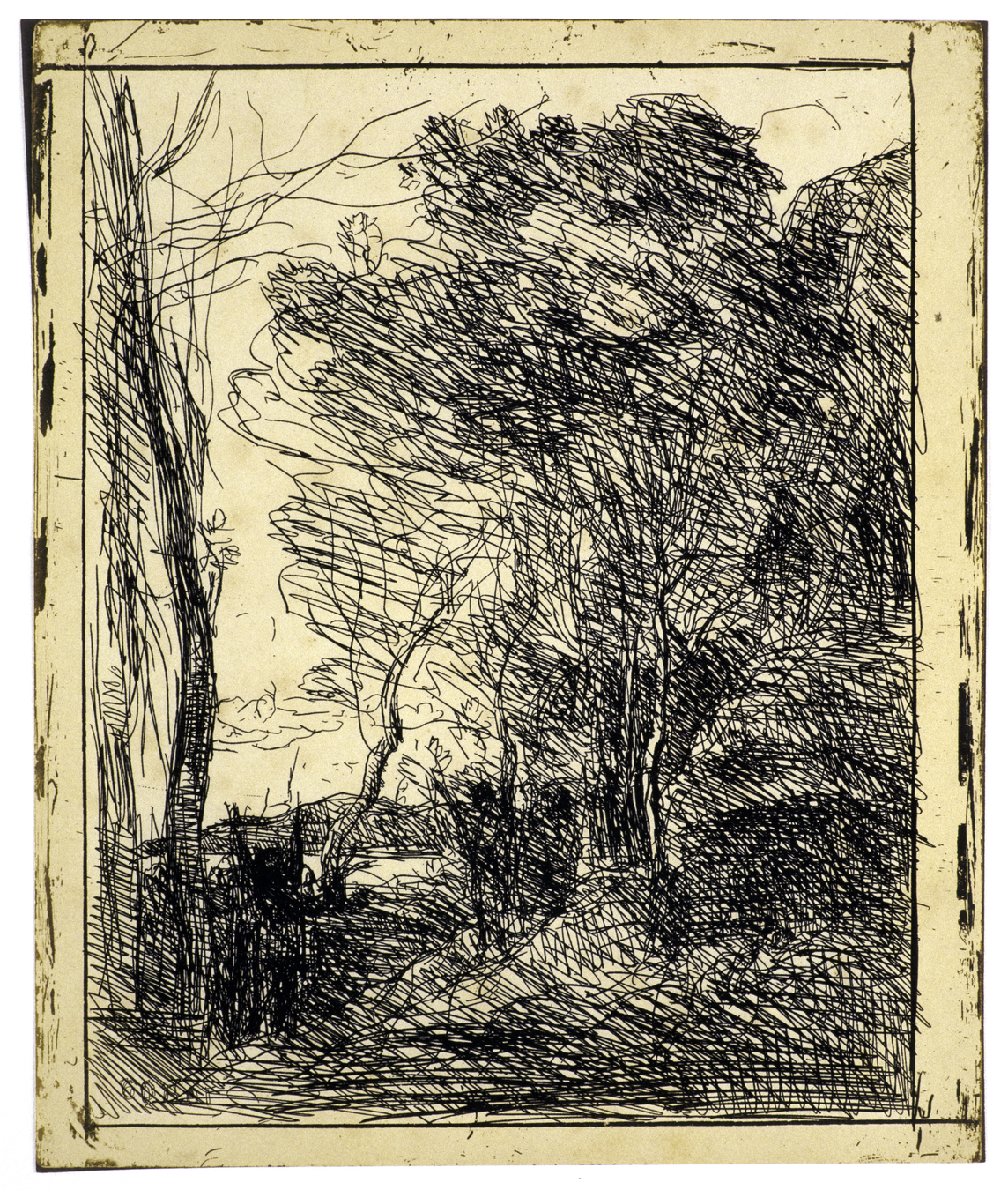
Trees take root in the uneven ground. Clouds float low in the sky, and mountains are visible beyond a leaning tree trunk. Perhaps that is a lake at the foot of the mountains? At first glance, the picture resembles a sketch layered with thin black ink lines, but it employs the technique known as cliché-verre (glass negative). The artist has used a sharp tool to scratch into a glass plate with an opaque coating, and a photographer has then exposed the resulting lines onto light-sensitive paper. This technique, brought from the northern French town of Arras, captured the interest of painters close to Corot, primarily those of the Barbizon school, but only for a brief period. However, Corot himself remained passionately committed to the technique—difficult to classify as either photography or printmaking—from 1853 until just before his death, leaving behind nearly 70 works.
(NAKAMURA Moe)