The objects of this still life are seen from a slightly elevated position. On the right are amaryllis flowers in a glass jug. On the left, a calf's head lies on an old newspaper on a simple wooden table dripping blood, with cauliflower and cabbage in the background. In the foreground, a torn piece of cloth hangs at a diagonal angle, connecting the calf to the jug. Western still life paintings have a tradition of depicting the transience of life with skulls and fallen petals. The artist Otto Dix spent four years as a soldier on the battlefields of World War I and experienced the reality of death firsthand. After his demobilization, he studied the precise techniques of German old masters, sketched corpses and organs at an anatomical laboratory, and produced a series of large paintings and prints on the subject of war. His approach to depicting his subject matter as it is, without empathy, is clear from this still-life, too.
(NAKAMURA Naoaki)

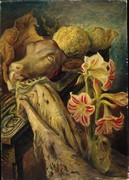
The objects of this still life are seen from a slightly elevated position. On the right are amaryllis flowers in a glass jug. On the left, a calf's head lies on an old newspaper on a simple wooden table dripping blood, with cauliflower and cabbage in the background. In the foreground, a torn piece of cloth hangs at a diagonal angle, connecting the calf to the jug. Western still life paintings have a tradition of depicting the transience of life with skulls and fallen petals. The artist Otto Dix spent four years as a soldier on the battlefields of World War I and experienced the reality of death firsthand. After his demobilization, he studied the precise techniques of German old masters, sketched corpses and organs at an anatomical laboratory, and produced a series of large paintings and prints on the subject of war. His approach to depicting his subject matter as it is, without empathy, is clear from this still-life, too.
(NAKAMURA Naoaki)