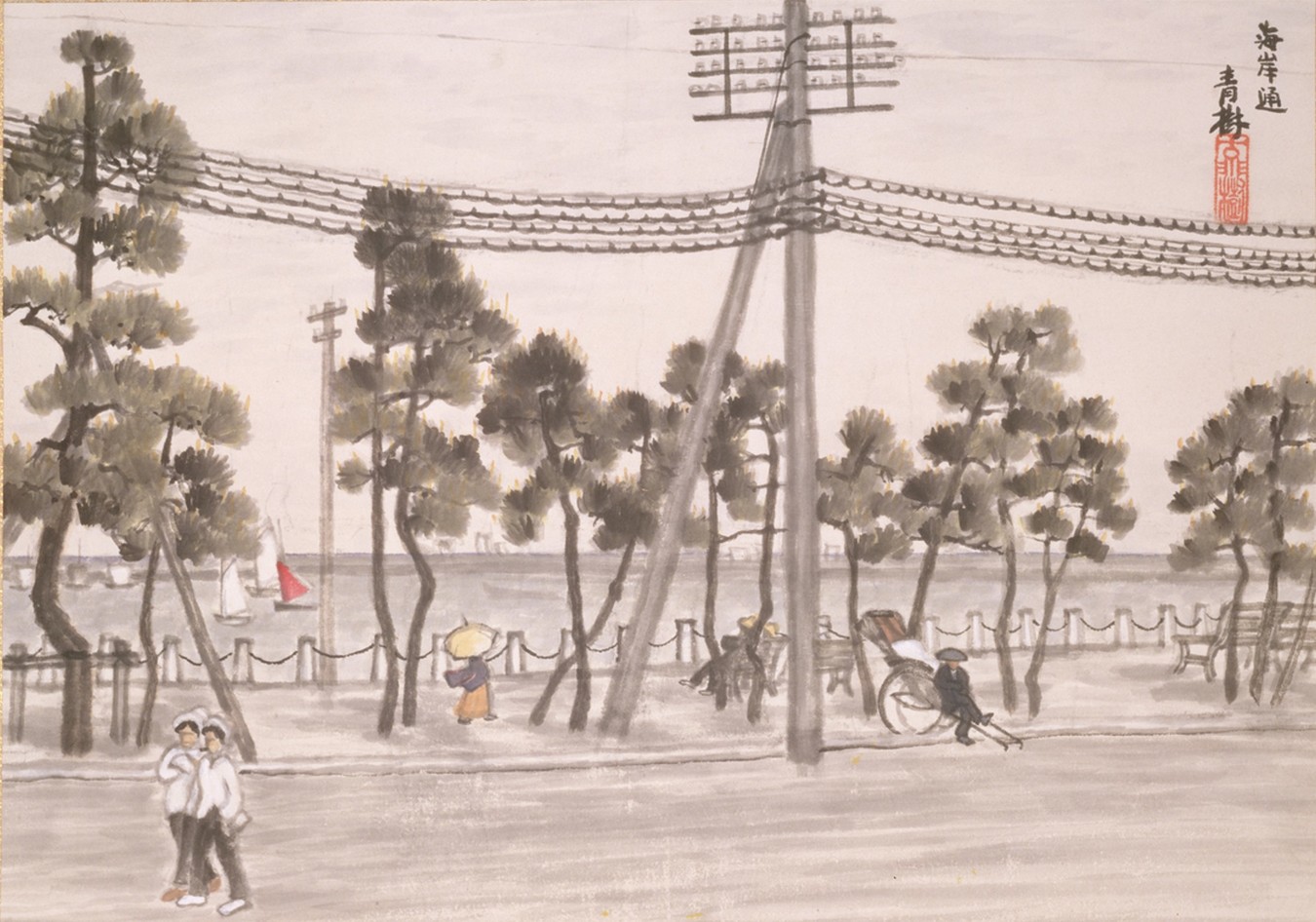
Omoda Seiju moved to Tokyo from Kawagoe at the age of 17. He studied Nihonga (modern Japanese-style painting) in Tokyo with Imamura Shiko and Hayami Gyoshu, and joined a group of young painters that were supported by the Yokohama-based collector Hara Sankei. This painting was made during a sketching excursion to Yokohama for an exhibition by the Sekiyokai, a study group formed around Shiko. The area depicted in the painting is present-day Yamashita Koen-dori, the main road running beside Yamashita Park. The area is now known for its ginkgo trees, but before the Great Kanto Earthquake of 1923 there were pine trees. Yachts can be seen in the background of the painting—typical of the town where yacht racing had first been introduced from the West and where it remained a popular pastime. After the earthquake, the area beyond the posts was reclaimed using rubble from the town’s collapsed buildings, and Yamashita Park was born. This painting is thought to be one of the “Sixteen True Views (Shinkei) of Tokyo and Yokohama” set, which Sankei listed in his collection inventory as having been “purchased at Sekiyokai”. (UCHIYAMA Junko)

Omoda Seiju moved to Tokyo from Kawagoe at the age of 17. He studied Nihonga (modern Japanese-style painting) in Tokyo with Imamura Shiko and Hayami Gyoshu, and joined a group of young painters that were supported by the Yokohama-based collector Hara Sankei. This painting was made during a sketching excursion to Yokohama for an exhibition by the Sekiyokai, a study group formed around Shiko. The area depicted in the painting is present-day Yamashita Koen-dori, the main road running beside Yamashita Park. The area is now known for its ginkgo trees, but before the Great Kanto Earthquake of 1923 there were pine trees. Yachts can be seen in the background of the painting—typical of the town where yacht racing had first been introduced from the West and where it remained a popular pastime.
After the earthquake, the area beyond the posts was reclaimed using rubble from the town’s collapsed buildings, and Yamashita Park was born. This painting is thought to be one of the “Sixteen True Views (Shinkei) of Tokyo and Yokohama” set, which Sankei listed in his collection inventory as having been “purchased at Sekiyokai”.
(UCHIYAMA Junko)