Domoto Hisao was born in Kyoto as the nephew of Domoto Insho, an artist who made Nihonga (modern Japanese-style painting). After graduating from university, Hisao also made Nihonga for a time, but in 1955 he went to France and switched to oil painting. One of the key artistic movements of the day in Paris was Art Informel, meaning art that was “formless.” In contrast to geometric abstraction (Cubism), which used cylinders, cones, and spheres as its basic forms, Art Informel sought to find the vitality of life within amorphous forms. This painting is from Hisao’s Informel period, characterized by a powerful, undulating intensity across the entire canvas. At the same time, his Nihonga roots are suggested by the painting’s sequence of narrow rectangles and earthen mound-like shapes, which are often seen in Eastern painting. (HIBINO Miyon)
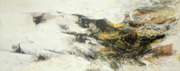
Domoto Hisao was born in Kyoto as the nephew of Domoto Insho, an artist who made Nihonga (modern Japanese-style painting). After graduating from university, Hisao also made Nihonga for a time, but in 1955 he went to France and switched to oil painting. One of the key artistic movements of the day in Paris was Art Informel, meaning art that was “formless.” In contrast to geometric abstraction (Cubism), which used cylinders, cones, and spheres as its basic forms, Art Informel sought to find the vitality of life within amorphous forms. This painting is from Hisao’s Informel period, characterized by a powerful, undulating intensity across the entire canvas. At the same time, his Nihonga roots are suggested by the painting’s sequence of narrow rectangles and earthen mound-like shapes, which are often seen in Eastern painting.
(HIBINO Miyon)