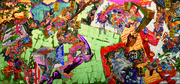
Shinohara Ushio was a central member of the avant-garde art collective Neo-Dada (Neo-Dada Organizers), formed in Tokyo in 1960. Pursuing a form of “anti-art” that deviated from conventional artistic concepts, the group’s activities included often eccentric performances. His “Boxing Painting” technique—striking a canvas with paint-covered gloves—became synonymous with his name. This monumental painting can be thought of as depicting the energy of Japan’s avant-garde art movement, which emerged around 1960. Artists from the Gutai (Gutai Art Association) movement, which was formed in Ashiya, Hyogo Prefecture, in 1954, created works strongly conscious of physicality. The bold composition evokes the warrior prints of ukiyo-e. It really feels as if heroes and warriors from both East and West are bounding into action. (UCHIYAMA Junko)
Shinohara Ushio was a central member of the avant-garde art collective Neo-Dada (Neo-Dada Organizers), formed in Tokyo in 1960. Pursuing a form of “anti-art” that deviated from conventional artistic concepts, the group’s activities included often eccentric performances. His “Boxing Painting” technique—striking a canvas with paint-covered gloves—became synonymous with his name.
This monumental painting can be thought of as depicting the energy of Japan’s avant-garde art movement, which emerged around 1960. Artists from the Gutai (Gutai Art Association) movement, which was formed in Ashiya, Hyogo Prefecture, in 1954, created works strongly conscious of physicality. The bold composition evokes the warrior prints of ukiyo-e. It really feels as if heroes and warriors from both East and West are bounding into action.
(UCHIYAMA Junko)