Okada Saburosuke was one of the most important artists who contributed to the development of Western-style painting in Japan in the latter half of the Meiji Era (1868–1912). This is considered an early work, having been made before his career really took off. At the time, Okada had two mentors, Soyama Sachihiko and Horie Masaaki. Both were among the first Japanese artists to study under Italian teachers at the Imperial College of Fine Arts, Ministry of Engineering, Japan’s first government-run art school, where they mastered authentic Western painting techniques. From Soyama, Okada learned to accurately capture and realistically reproduce his subjects, while from Horie he learned the principles of color based on the three primary colors. In this painting, one can see how Okada has internalized the teachings of both mentors, with a keen focus on verisimilitude and capturing not only the skin’s texture and color variations, but every wrinkle. (HIBINO Miyon)
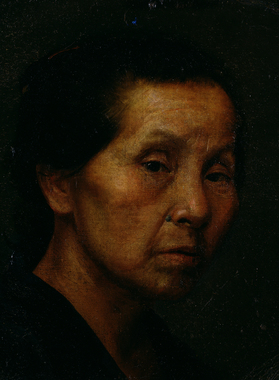

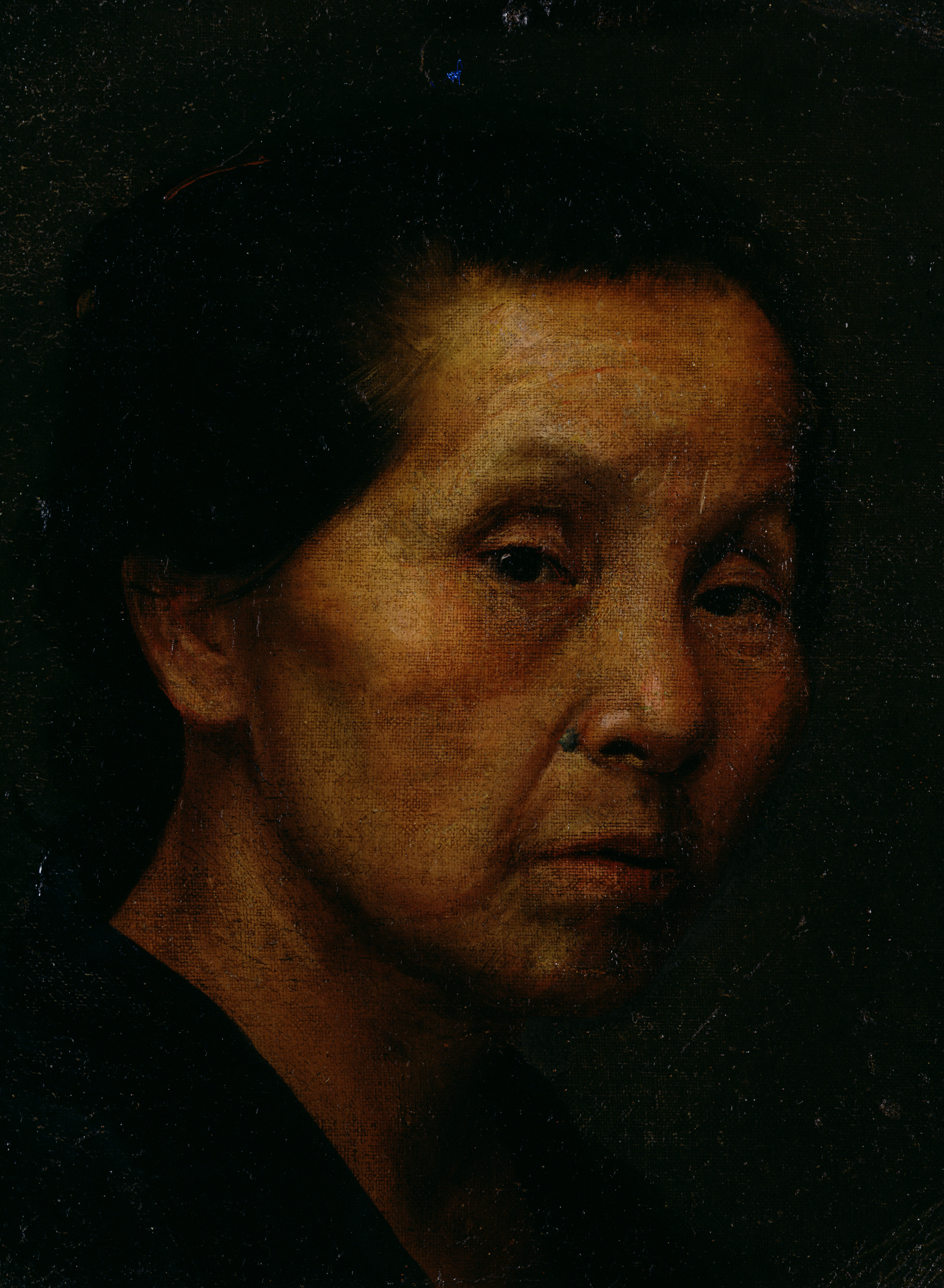
Okada Saburosuke was one of the most important artists who contributed to the development of Western-style painting in Japan in the latter half of the Meiji Era (1868–1912). This is considered an early work, having been made before his career really took off. At the time, Okada had two mentors, Soyama Sachihiko and Horie Masaaki. Both were among the first Japanese artists to study under Italian teachers at the Imperial College of Fine Arts, Ministry of Engineering, Japan’s first government-run art school, where they mastered authentic Western painting techniques. From Soyama, Okada learned to accurately capture and realistically reproduce his subjects, while from Horie he learned the principles of color based on the three primary colors. In this painting, one can see how Okada has internalized the teachings of both mentors, with a keen focus on verisimilitude and capturing not only the skin’s texture and color variations, but every wrinkle.
(HIBINO Miyon)