
Kara Kara (original: Kara Kara)
カラカラ(原作:カラカラ)
- Birth Year
- 1904
- Death Year
- 2001
- Date
- reproduced in 1973 (original: 1936)
- Technique, Material, Format
- lacquer on plywood, nylon thread
- Dimension
- 90.0 x 78.0 cm
- Category
- Oil or Other Painting by Japanese Artist
- Inventory Number
- 93-OJ-005
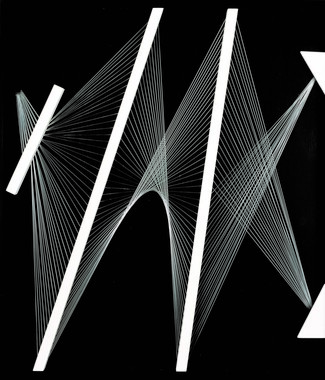
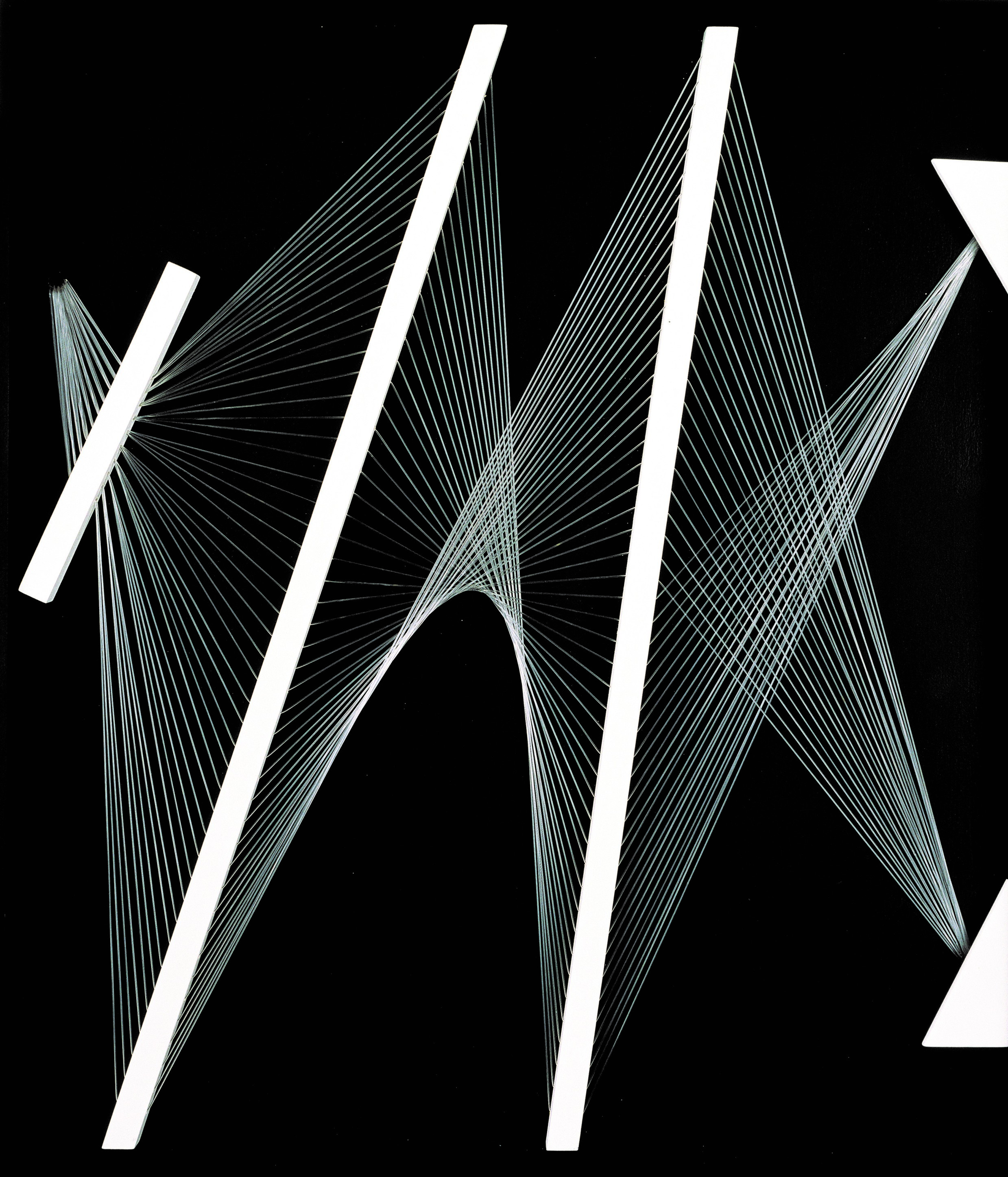
White-painted wooden struts are positioned on a black board with nylon thread stretched across them. The threads twist and intersect, giving a sense of depth. Is it a painting? Is it three-dimensional? What does it represent? The mechanical beauty of the accumulation of lines and the distinct pattern of black and white seems to lull viewers into a soothing rhythm. The work dates from a time when Saito Yoshishige was influenced by Constructivism (a Russian art movement characterized by geometric forms incorporating industrial materials). The work’s title, Kara Kara, is an onomatopoeic expression meaning “parched.” It was apparently chosen because that’s how the artist felt when he made it. That almost mocking simplicity and toy-like sound make it a particularly memorable title.
(UCHIYAMA Junko)