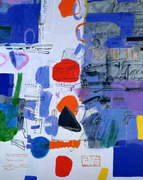
Sano Nui was born in Aomori in 1932 to a confectioner. The family’s shop included a café space, where reproductions of Western paintings were hung and classical music was played. It attracted literary figures and painters who were friends of her father, himself a lover of literature. After growing up in that cultural melting pot, Sano went to art university. "The color blue must hide so many of the things it longs to say," she lamented. Much of her work was a dialogue with blue. It was not just a characteristic feature of her work, but a theme. The colors depicted here range from bright, clear blues to calm, deep ones. The delicate resonance between these blues and the other colors seems to evoke the hubbub of the city in the afternoon.
(KATADA Yuko)
Sano Nui was born in Aomori in 1932 to a confectioner. The family’s shop included a café space, where reproductions of Western paintings were hung and classical music was played. It attracted literary figures and painters who were friends of her father, himself a lover of literature. After growing up in that cultural melting pot, Sano went to art university. "The color blue must hide so many of the things it longs to say," she lamented. Much of her work was a dialogue with blue. It was not just a characteristic feature of her work, but a theme. The colors depicted here range from bright, clear blues to calm, deep ones. The delicate resonance between these blues and the other colors seems to evoke the hubbub of the city in the afternoon.
(KATADA Yuko)